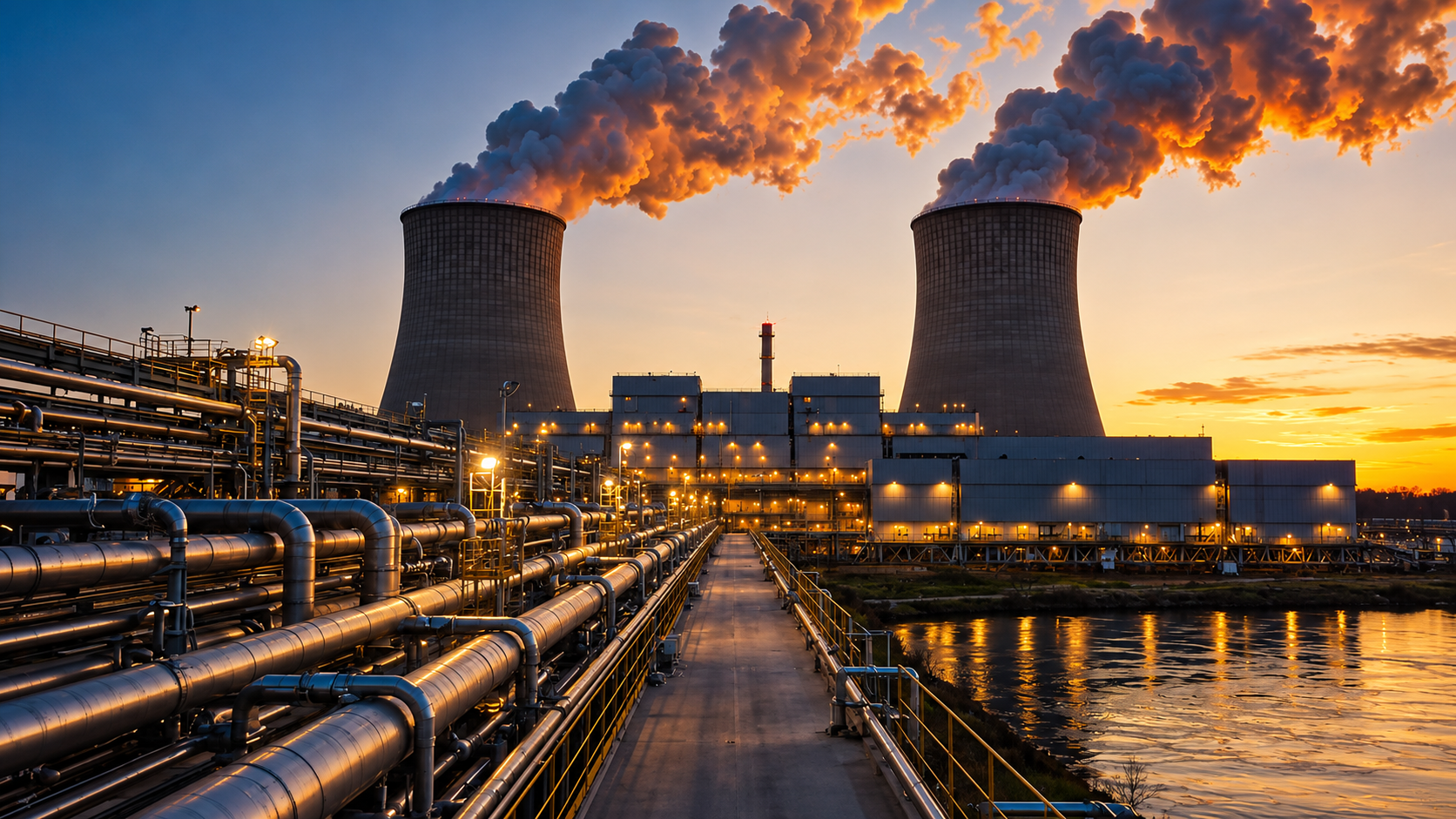
AI infrastructure is no longer a technology problem.
It is a power, land, and transmission strategy problem.
Hyperscalers building the next generation of AI compute campuses have discovered that the binding constraint is not chips, capital, or engineering — it is firm, carbon-free power at 500 MW to 1+ GW per campus, in the right corridor, with the right transmission access. Nuclear-adjacent land is the only category that satisfies all three conditions simultaneously.
The energy procurement strategy for AI infrastructure has shifted fundamentally. Five years ago, hyperscalers approached power as a commodity procurement problem — buy renewable energy credits, source some on-site solar, accept grid power as the marginal source. Today, power is a land and transmission strategy problem. The binding constraints are no longer capital or engineering. They are firm baseload capacity and the transmission infrastructure to access it.
Why Nuclear Adjacency Is the Only Path
AI training campuses running at 500 MW to 1+ GW continuous draw require power sources that operate 24/7 at 90%+ capacity factors. Wind averages 28–35%. Solar averages 22–25%. Battery storage is prohibitively expensive at multi-gigawatt scale. Nuclear is the only proven technology that delivers firm carbon-free baseload at the scale and reliability hyperscalers need. Nuclear-adjacent land is attractive not for philosophical reasons but for economic ones: the transmission infrastructure is already in place, the utility relationships are established, the water cooling infrastructure is adjacent, and the regulatory pathway for co-location has now been clarified by FERC.
The Transmission Queue Crisis Makes Nuclear Mandatory
New interconnection requests in PJM face 8+ year queue waits. A hyperscaler filing a greenfield site request today will not see queue confirmation for nearly a decade. Meanwhile, nuclear plants have existing high-capacity transmission connections engineered for 1,000+ MW output, with established utility relationships and regulatory precedent for operation. FERC's December 2025 co-location order removed the regulatory ambiguity that had prevented hyperscaler commitment. It established three pathways for data centers to connect directly at nuclear facilities, each with defined cost allocation and interconnection timelines measured in months, not years.
How Meridian Powers Hyperscaler Siting Strategy
Meridian advises hyperscalers and infrastructure developers on the full spectrum of nuclear-adjacent siting: site shortlisting against SiteScore™ benchmarks, corridor viability analysis via PowerMap™, transmission queue position mapping, utility relationship assessment, water access validation, and counterparty targeting strategy. Our role is to compress the decision timeline — to show clients not just which sites are available, but which sites can be acquired and developed before the corridor is locked.
The CTA
If your organization is evaluating power strategy for AI infrastructure deployment, nuclear-adjacent siting must be part of that evaluation. The transmission advantage is structural. The regulatory pathway is clear. The capital is moving. Engagement with Meridian begins with a site intelligence briefing tailored to your corridor focus and capacity requirements. We will show you what GridMind's intelligence reveals about viability, timing, and positioning for your target geographies.
AI training clusters have crossed the gigawatt threshold.
The infrastructure world has not caught up.
The generational shift in AI compute demand is not incremental. It is a step function — and the power infrastructure required to support it was never designed for this load profile. The gap between what hyperscalers need and what the grid can deliver is the market Meridian operates in.
Publicly committed hyperscaler AI power demand across 2025–2027 capital programs
Estimated U.S. AI infrastructure investment committed or in active development through 2030
Average interconnection queue wait time for new transmission access requests in PJM territory
Brokerable nuclear-adjacent AI power capacity tracked in the GridMind dataset across 15 states
Compute density has crossed 1 GW per campus
The largest next-generation AI training facilities — GPT-6-scale, Gemini Ultra successors, and proprietary foundation model clusters — are being engineered for 500 MW to 1.2 GW of continuous power draw. Single-site load requirements have increased 40× in a decade.
Carbon-free mandates are non-negotiable for hyperscalers
Microsoft, Google, and Amazon have each made binding commitments to 24/7 carbon-free energy by 2030 or sooner. Renewable energy certificates do not satisfy the 24/7 CFE standard. Only nuclear power — with its continuous baseload output — meets the requirement without geographical constraints.
Geographic saturation is forcing operators into new corridors
Northern Virginia, Phoenix, Dallas, and Chicago — the legacy hyperscale markets — face power moratoriums, transmission congestion, and land scarcity. Operators are now mapping second and third-tier markets, with nuclear-adjacent corridors in Pennsylvania, Ohio, Illinois, and the Southeast rising in priority.
Water access is emerging as the fourth constraint
Liquid-cooled AI clusters require 50–120 million gallons of water annually per campus. Nuclear facilities were sited on rivers, lakes, and reservoirs to meet their own cooling requirements. Adjacent parcels inherit proximity to that water infrastructure — a non-trivial advantage in markets where municipal water allocation is politically constrained.
Not all nuclear-adjacent land is equal.
Corridor position determines everything.
GridMind's PowerMap™ system divides U.S. nuclear-adjacent AI power opportunity into four active corridors — each with distinct transmission tiers, utility relationships, regulatory postures, and hyperscaler demand proximity profiles. Knowing where a parcel sits within this framework is the first determinant of its strategic value.
PJM Core
The highest-priority corridor in the GridMind dataset. PJM operates the world's largest electricity market by area, with the deepest concentration of operating nuclear plants and the most mature transmission infrastructure for AI power delivery. Susquehanna (PA), Perry (OH), and Salem (NJ) cluster areas lead the corridor rankings.
Midwest Nuclear
Illinois hosts the largest concentration of nuclear generation capacity in the United States. The Dresden, Braidwood, Byron, and Quad Cities clusters offer significant adjacent land inventory, favorable utility posture (Exelon/ComEd relationship), and strong state-level nuclear policy support. Demand proximity to Chicago hyperscale market adds a meaningful AI demand score component.
Southeast Nuclear
Driven by Vogtle Unit 3 and 4 (the newest operating nuclear units in the U.S.), Catawba, McGuire, and Oconee adjacencies, and significant state-level policy support for nuclear development. Duke Energy and Southern Company utility relationships provide strong off-take pathway access. Demand proximity is growing as hyperscalers expand Southeast campuses.
Sun Belt & Texas
Led by the Palo Verde Nuclear Generating Station in Arizona — the largest nuclear plant in the U.S. by output — and the Wintersburg development corridor. Texas ERCOT territory adds complexity (isolated grid) but demand proximity to major hyperscale markets is strong. SMR development pipeline adds optionality for longer-horizon positioning.
Every site we evaluate is scored the same way.
No narrative substitutes for data.
GridMind's SiteScore™ is a 100-point composite scoring system applied uniformly across every nuclear-adjacent AI power site in the dataset. It produces a defensible, benchmarked ranking that replaces subjective site evaluation with a structured intelligence framework. Every Meridian advisory recommendation is anchored to a SiteScore position.
Parcel Identification
All parcels within 30 miles of operating or recently decommissioned nuclear facilities with minimum 100-acre land area
Transmission Screening
Interconnection queue analysis, substation proximity, voltage tier, and line capacity for AI-scale load delivery
Demand & Market
Hyperscaler campus proximity, fiber route density, AI campus announcement density, and internet exchange proximity
Development & Execution
Entitlement status, zoning classification, permitting velocity, FERC queue position, and shovel-ready infrastructure
Policy, Water & Community
State nuclear policy and incentives, water rights and environmental risk, and local community / EDO alignment — three domains capturing external enablers and execution risk
Transmission access tier, interconnection queue position, substation capacity, voltage level, and clean baseload generation proximity
Hyperscaler campus distance, fiber density, AI campus announcement density, internet exchange proximity, and co-location precedent
Permitting status and velocity, zoning classification, acreage and site readiness, FERC queue position, and shovel-ready infrastructure
State nuclear policy, data center tax abatements, DOE funding region overlap, and regulatory / permitting velocity
Water source proximity and rights, annual availability and drought risk, environmental impact history, and flood / disaster exposure
Community support history, local STEM workforce, EDO alignment, and prior nuclear or industrial development presence
Hyperscalers are already committing.
The window for advisable positioning is now.
The largest AI infrastructure operators have publicly announced nuclear-adjacent commitments at a scale and pace that validates the strategic thesis. The deals below represent a fraction of the total activity GridMind tracks — most of the market is moving without public disclosure.
Multi-state nuclear-adjacent data center investment program announced 2024–2025, including direct nuclear power agreements and campus development adjacent to PJM territory operating plants.
PJM Core · Tier I CorridorNuclear-adjacent AI infrastructure campus adjacent to Prairie Island Nuclear Generating Station in Minnesota. Xcel Energy nuclear off-take structure. Part of Microsoft's multi-state nuclear power procurement program.
Midwest · Tier I CorridorNuclear power agreement for 1,121 MW of capacity from EDF's Clinton Power Station in Illinois, underwriting Meta's Midwest AI infrastructure expansion with direct nuclear baseload allocation.
Midwest Nuclear · Tier I CorridorMulti-state nuclear power agreement spanning 24 utilities and 6.6 GW of total contracted nuclear capacity — the largest single nuclear power procurement in U.S. history, covering all four PowerMap corridors.
Multi-Corridor · All Tiers25-year power purchase agreement with NextEra Energy for 615 MW of nuclear generation from the Duane Arnold Energy Center — Iowa's only nuclear facility, shut since 2020 and targeted to return to service early 2029 — supporting Google's Midwest AI power expansion and 24/7 CFE commitments.
Midwest Nuclear · Tier I CorridorFERC's landmark transmission planning reform order materially improved the economics of nuclear-adjacent parcels with existing substation infrastructure, reducing interconnection cost exposure for AI-scale load additions.
Regulatory Catalyst · All Corridors